
Blog about Biology and all that
Thursday, 5 December 2013
Angiosperm

Gymnosperms
Ferns
Moss
Wednesday, 4 December 2013
Pollination


Monday, 2 December 2013
Monocot and dicots - roots


Thursday, 28 November 2013
Mimosa Pudica
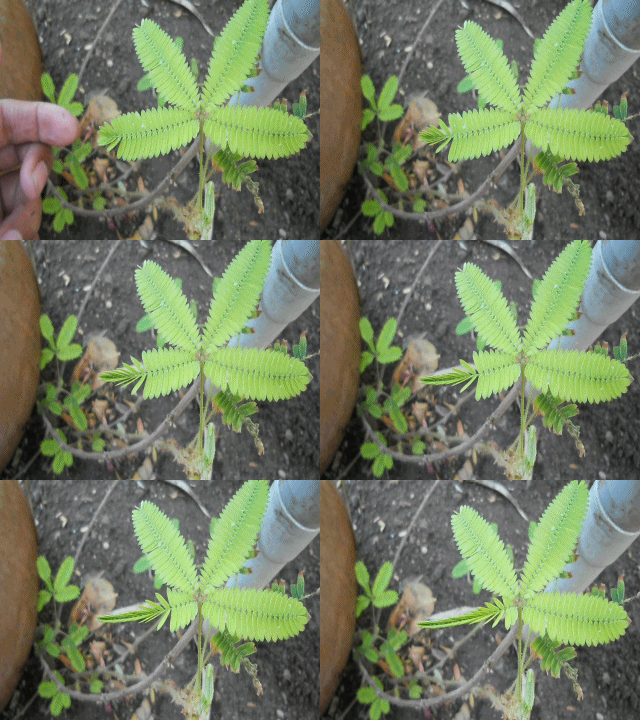 This plant is like no other. It reacts to touch! If any animal or thing in general comes into contact with the plant, it will shrink back and become smaller. Other names for this plant that are commonly used are; Shrinking plant, Sleepy Plant and the "Touch me not". The reason that the leafs on the plant shrink back is because to protect themselves against predators who would want to eat the plant. You can find this amazing plant in South America and Central America. Grows in shady conditions.
My Super cool plant
My unique and strange plant s called the Dracunculus Vulgaris. What makes this plant so extraordinary and interesting is that this plant releases an odour of raw meat which attracts flies to the plant in order for them to pollinate the plant. The plant is found in Northern Europe and North America. Despite its weird strategy to attract flies and that odour, this plant is commonly found around and is not harmful to humans. There are many different names for this plant such as Dragon Arum, Voodoo Lily. Snake lily and also the Stink Lily. It's amazing how plants have adapted in order to become fertilized. Below is a video on the plant and how the plant functions.
Difference between PineCones and Acorns

Monday, 25 November 2013

Tuesday, 19 November 2013
Thursday, 14 November 2013
Mid-term evaluation
Classification and Taxonomy
So far in the Biology course I have shown an okay understanding of Classification. I got 8/15 on my classification quiz, however I think I could have done much better since it was the first quiz and if I were to do it right now my mark would be different in a positive way. I lost most marks on
organelles ex. Humans. Prokaryotic is quite the
opposite with the organism having no nucleus or organelles ex.Bacteria. http://asadssupercoolbilogy.blogspot.ca/2013/09/kpcofgs-of-pantcher.html

in the evolution topic i learnt about how factors such as Natural Selection can bring about Evolution to animals in an environment. The main thing about the whole natural selection topic which is most important is that it is survival of the fittest and the animal that is most well adapted to the environment will survive. i have attached an assignment about how certain animals have evolved to survive and this assignment gave me a great deal of information on the topic. i received 5/5 on the questions and on the quiz i got 17/20. proving that i know my stuff on Evolution. I have also attached an assignment on the different types of selection in an environment and which is most common. that worksheet helped me understand evolution the best and helped me get good at it. Me and my group made a video all about DNA and how it changes with Evolution. By doing this video it gave me an even clearer understanding of Evolution and how it occurs.http://asadssupercoolbilogy.blogspot.ca/2013/10/our-video.html


Viruses
During the Virus topic I learnt about the structure of a virus and all the components that make the virus up. I achieved a 17.5/20 on my Virus test which shows that I understand the topic well. Below I have attached a blog post on a virus I have studied thoroughly through, which was Swine Flu. Because I had studied why a virus effects certain things and how to prevent them from attacking, i was able to achieve the mark I did on the Quiz.http://asadssupercoolbilogy.blogspot.ca/2013/10/the-swine-flu.html
Bacteria
 This was one of my favorite topics so far in the course of Biology 11. I learned a great deal about how the bacteria functions and all the parts that make up the bacteria such as cell wall, cytoplasm, the dna and more. I compared the differences between the Virus and Bacteria and how they are also similar. Doing this helped me achieve a solid mark for my Bacteria quiz and allowed me to understand what Bacteria is. The biggest assignment that made me learn how bacteria grow and colonize was the agaar plate experiment that was done in the lab taking tests from different areas in the school and leaving it for a day. Below I have attached some results from the lab. I learnt and was fascinated by the 3 different shapes of bacteria; Staphlo, Bacilium and Coccus.
Protists
This was a very interesting topic to learn. Mainly because of the great deal of time spent finding different moving organisms under the microscopes. I compared the Protists and Bacteria and what makes up each cell and this helped me understand the whole topic alot more easier. I learnt that Protists live near aquatic areas and that the area needs to be moist for ideal conditions. I also learnt that Protists use binary fission as a means to reproduce which helps them reproduce quickly rather than the normal process of Meiosis. I happened to find a funny yet informative video on Protists and how they live and what they do. The class enjoyed this video as much as I do. http://asadssupercoolbilogy.blogspot.ca/2013/10/my-protist-research.html

Last remarks
I would like to say that Biology has always been one of my favorite subjects. I moved from a school where the sciences are very hard, since it was a British school (Doha College). A lot of the stuff that we learn in class such as the whole Evolution topic and the Taxonomy are all stuff I have learnt. I know my marks should be higher than they are right now but I think the reason for my marks not being where I ideally want them to be is because I'm taking it too easy. When I was living in Qatar I was being pushed to work hard and study but when I come to this class I dont feel the urge. I'm not blaming the teacher but I'm trying to say that I am old enough to push my self to do good because I find much of the stuff very easy. I love participating in class and giving my own input on what I think about a topic and enjoy discussing interesting things. I get along with all the people in my class and enjoy socializing (which needs to be cut down a bit). I am really trying to do my best in school and I have been doing well in all my other classes. Based on my quizzes and blogpost as well as completed assignments, I think I deserve a 76%. I have lots of room to improve in this course and I'm willing to put the effort into doing it as I know that I can achieve my goal of an A for sure :)
Wednesday, 6 November 2013
Hitler bug
The hitler bug is called Anophthalmua hitleri. It is a species of blind cave beetle found in Slovenia. Species name was made a dedication to Adolf Hitler who had recently become Chancellor of Germany. Hitler thanked the german who made the species named after him. Has no special characteristics.
kingdom: Animalia
Phylum: Anthropoda
Class: insecta
Order: coleopatra
Family: caribadae
Genus: anophthalmus

Glowing mice
Some mice have been genetically modified to assist in the study of human diseases. One way of genetically modifying the mice is to do a pro nuclear injection into a single cell of a mouse embryo where it spreads. There are transgenic mice expressing green fluorescent protein. Which glows green under blue light.
http://www.forbes.com/2001/07/26/0726gfp.html
Monday, 28 October 2013
Algae
We looked at green algae today in the lab, we found many gyros which basically took up the whole slide. The green is visable from the outer side of the slide and this allows us to clearly view the algae

Wednesday, 23 October 2013
Thursday, 17 October 2013
Bacteria destroying test
Abby, shimmi, brittany and my self gathered bacteria from the PE staff room and put it in the container. We then used water, sanitizer, bleach and a control. These were used to test to see which things would destroy the bacteria. So far after a day, we have seen that the bleach has destroyed it the most.
I think that we could not do the same test with viruses because viruses effect living things even though they reproduce. Maybe if there was some living things inside the agaar plates

Wednesday, 16 October 2013
Bacteria growing
Top left: staff room
Top right: mr d room
Bottom left: hand rail
Bottom right: pe room

Monday, 7 October 2013
The swine flu


Virus

Tuesday, 1 October 2013
Why do male Lions have Manes?\
Monday, 16 September 2013
Question?!


Similarities and differences of the KPCOFGS


Thursday, 5 September 2013
Why are all or most plants green?
http://www.youtube.com/watch?v=aAQYpra4aUs
http://www.pa.msu.edu/sciencet/ask_st/081496.html